
Funnel, tornado, and the reporting threshold
There is a bright line between a funnel cloud and a tornado, it is written down, and it is not about how the thing looks.
The test
Learn this sentence. It is the one module 7 will make you use verbatim, and it decides what you say on the radio.
Everything else follows. A rotating funnel hanging aloft with no ground contact and nothing being kicked up underneath it is a funnel cloud. It is reportable, and it is a different report with different words and a different urgency.
The half everyone forgets
Clause (b) runs in both directions, and the NWS glossary says the harder direction out loud: "a debris cloud appearing beneath a thunderstorm will confirm the presence of a tornado, even in the absence of a condensation funnel."
A tornado is a column of rotating air. The visible funnel is condensation, which happens when the pressure drops far enough for the moisture present to condense, and on a drier day it may never happen at all while the circulation is doing full damage at the ground. No funnel does not mean no tornado.
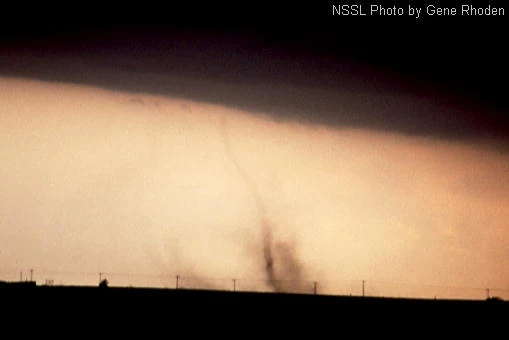
The The last phase of a tornado, when the funnel stretches, tilts and narrows into a contorted rope before dissipating. Still a tornado while it lasts.
As a tornado dies, the circulation stretches, tilts and narrows, and the funnel "takes on a contorted, rope-like appearance before it completely dissipates". That is the rope stage, and it is still a tornado. It is dissipating, not dissipated.
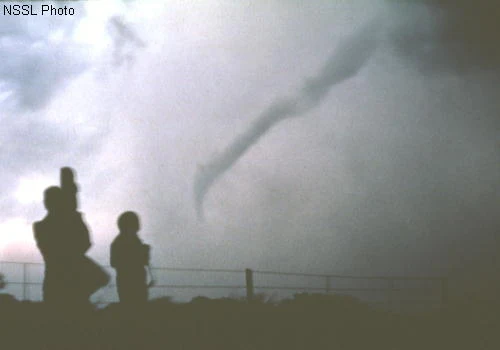
Funnel or Ragged low cloud that forms in humid air near a storm and drifts about. It rises slowly and does not rotate, which is what separates it from a funnel, and it is the single most common thing mistaken for one.
This is lesson 5 arriving at the moment it matters. The discriminator is rotation, and only rotation. A funnel rotates continuously about a vertical axis and holds a coherent shape while doing it. Scud drifts, rises, changes shape and does not rotate.
One more case, because humid climates produce it constantly and lesson 9 is about it: the funnel may be there and simply invisible behind rain. A Hidden inside the precipitation around it. A rain-wrapped tornado breaks none of the identification rules; it just denies you the observation those rules rely on. tornado breaks none of the rules above. It just denies you the observation the rules are built on.
Beneath a storm base you can see a swirl of dust and debris being lifted and rotated at the surface. There is no condensation funnel anywhere above it. What do you report?
The threshold has two clauses joined by "or", and this is the second one.A tornado. The NWS is explicit that "a debris cloud appearing beneath a thunderstorm will confirm the presence of a tornado, even in the absence of a condensation funnel". The funnel is condensation and it is optional; the rotating column of air is the tornado. Lesson 8 covers when surface debris is instead a gustnado, and the difference is whether the circulation connects to the storm above.