
Estimating and measuring wind
The severe threshold, the NWS estimation chart in full, and the well-documented reason a number you guessed is worth less than a sentence describing what moved.
The numbers
The chart, verbatim
NWS New Orleans and Baton Rouge, derived from the Beaufort scale, reproduced exactly including the severe line placed between the 54 and 63 mph rows.
Notice what the chart is actually made of: things you can see happening to objects. Twigs breaking. Whole trees moving. Walking made difficult. It is not asking you to know the wind speed. It is giving you a way to bound it from something observable, which is the right way round.
Why your number is probably too high
Two studies, and they are worth knowing by name because this is a claim about you.
Trapp and colleagues compared The official national archive of significant weather events and their impacts, published by NOAA and built largely from local storm reports. It is the source almost every long-term severe weather statistic comes from. wind reports against proper damage surveys and found the reports "served as a poor characterization of the actual scope and magnitude of the surveyed damage", sometimes overstating minor events and sometimes understating major ones. The paper is titled *Buyer Beware*.
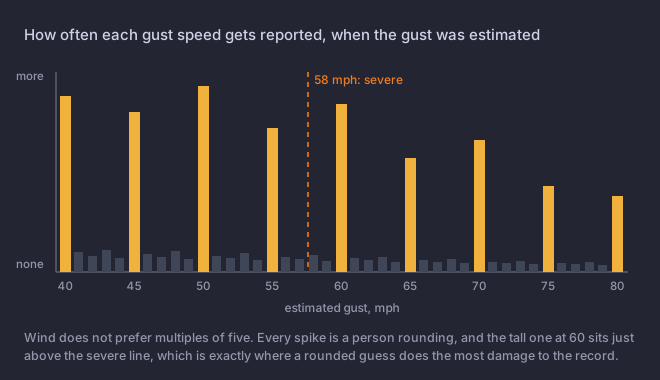
Edwards, Allen and Carbin then looked at the shape of the numbers themselves: 150,423 convective gusts over a decade, of which 135,240 were estimated and only 15,183 measured. The estimates spike, unphysically, on values ending in 0 or 5.
Measured, and what that word means
Storm Data has separated MG, measured gust, from EG, estimated gust, since 2006. NWS Instruction 10-1605 puts it: "If known, maximum gusts will be encoded as 'measured;' otherwise, they will be an estimate". The same instruction rules out one tempting shortcut: "Doppler-derived wind speeds will not be used to determine the character of the storm."
Neither the instrument behind an MG nor the person behind an EG is usually recorded, which is worth knowing before you treat a measured value as authoritative. This platform carries the same flag, and weights measured gusts higher without discarding estimates.
What counts as measured
The WMO standard is unambiguous: wind instruments over level, open terrain are exposed ten metres above the ground, with open terrain meaning obstructions are at least ten times their own height away.
- A backyard station on a roof is not at 10 m over open terrain. Roof-mounted units are usually under-exposed and read low, or sit in accelerated flow over the ridgeline and read gusty. Report the number and say what it came from.
- A vehicle-mounted An instrument that measures wind speed. The standard exposure is ten metres above open ground, which almost no backyard or vehicle-mounted unit achieves. is invalid while moving, and needs correcting for vehicle motion even when stopped. Parked, into the wind, on a known instrument, it is a real measurement.
- Sustained is not gust. Wind speed averaged over a period, typically two minutes at an automated station. A gust is a brief peak, and reporting one as the other changes the meaning entirely. is an average, typically over two minutes at an automated station; a gust is a brief peak. Reporting one as the other changes the meaning entirely.
- The units are interchangeable, the threshold is one number. 1 knot is 1.151 mph. 58 mph is about 50.4 knots, which is where the 50 kt criterion comes from.
You watch whole trees moving and find it hard to walk against the wind, then estimate the gust at 60 mph. What is the most useful thing to report?
One option invents a number to fit a threshold, and one throws away a real observation.The description is the observation; the number is a guess on top of it, and estimated gusts spike unphysically at multiples of five, with 60 sitting just above the severe line. Report both, flag the estimate as an estimate, and let the office weigh it. Whole trees in motion and difficulty walking is the chart's 32 to 38 mph row, which is worth noticing about your own 60.