
Where you may stand
Private land, damage zones, police lines and curfews, and why the most useful thing you can do at a disaster scene is usually to not be in it.
Land
Trespass is state law and the detail varies, but the principle is consistent enough to teach: entering or remaining on somebody else's land without permission is a wrong, and notice makes it clearly criminal. Notice can be a fence, a sign, or somebody telling you to leave. Some states require land to be posted before entry is an offence; others do not.
Damage zones
After a damaging event a perimeter goes up, and it is backed by real criminal law. The offences differ by state and the categories do not.
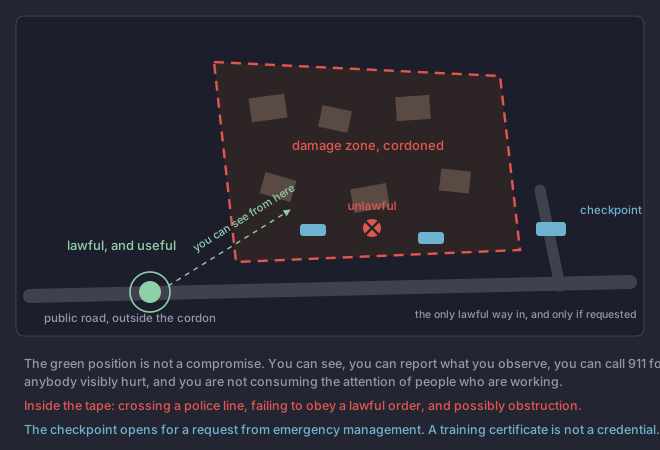
- Crossing a police line or entering a closed area. Typically a misdemeanour, and the tape is the notice.
- Failing to obey a lawful order to leave, to disperse, or to stay out. Usually a separate offence from the first.
- Violating a curfew or a post-disaster access restriction. Common after a major event, and enforced at checkpoints.
- Obstructing or interfering with police, fire or medical responders. The one that carries the most weight, and it does not require you to physically block anybody.
Why you do not self-deploy
This is the part that catches decent people, because the impulse is a good one. Something terrible has happened nearby, you have training and a vehicle, and going to help feels obviously right.
Module 10 lesson 5 described the incident management structure. The relevant property here is that it works by somebody knowing who is present and what they are doing. An unrequested arrival breaks that in three ways at once.
- You consume supervision. Somebody has to work out who you are and whether you are a hazard, and that somebody has other things to do.
- You are unaccounted for. If the scene is evacuated or something collapses, nobody knows you are there.
- You may become a casualty, converting one person who came to help into another person who needs it. Module 8 covered the hazards in a damage zone: live lines, gas, unstable structures, standing water.
None of this means driving past somebody trapped in a car. Lesson 7 covers rendering aid, and the distinction that matters is between helping the person in front of you and inserting yourself into an organised response. The first is human. The second is a problem.
You arrive at a neighbourhood levelled by a tornado. A police line is up. What is the correct sequence?
Three of these are wrong, and one of them is wrong in the opposite direction from the other two.Crossing the line is a criminal offence and makes you a supervision problem and a potential casualty in an organised response. But the last option is also wrong: you can call 911, you can report what you observe from where you lawfully are, and a damage report from outside the cordon is a real contribution.