
When to report
Occurrence time against reporting time, why a warning already being out is a reason to report rather than not to, and the tag ladder your report can push a storm up.
As soon as it is safe, which is not the same as immediately
The office asks for it plainly: "please submit your report as soon as possible after a severe weather event", and "Always include the time the event happened and the location." Note the word after. Nothing in that sentence asks you to report during the event from an exposed position, and module 8 has a great deal more to say about that.
Occurrence time, not call time
This is the single most common defect in otherwise good reports. The report carries the time the thing happened. If hail fell at 4:52 and you called at 5:10 from somewhere with signal, the report is a 4:52 report.
For the archive, The official national archive of significant weather events and their impacts, published by NOAA and built largely from local storm reports. It is the source almost every long-term severe weather statistic comes from. has its own convention, and it is worth knowing because it trips people up: "Use local standard time in 24-hour clock throughout the year." Standard time, all year, including through the summer. That is an archive convention rather than something you need to do the conversion for.
The office can convert. It cannot recover a time you gave wrong, and a five-hour error near midnight moves the report to the wrong day.
There is already a warning out
The most common reason people do not report is that the warning is already issued and they assume they are too late to matter. Three separate things say otherwise.
- Checking afterwards whether warned events happened and unwarned ones did. It leans almost entirely on reports, which is why a late report still counts for something.. Whether the warning was right is decided by reports. A warned event with no report looks, in the record, like a false alarm.
- Extension and upgrade. Warnings get extended in time and space, and a Severe weather is happening or about to happen for the people inside a drawn polygon. Issued by the local forecast office. It means act now. becomes a tornado warning, on the strength of reports.
- Tags. A warning carries a damage threat tag, and your report can move it up the ladder. That is not a paperwork change; the top tag sets off phones.
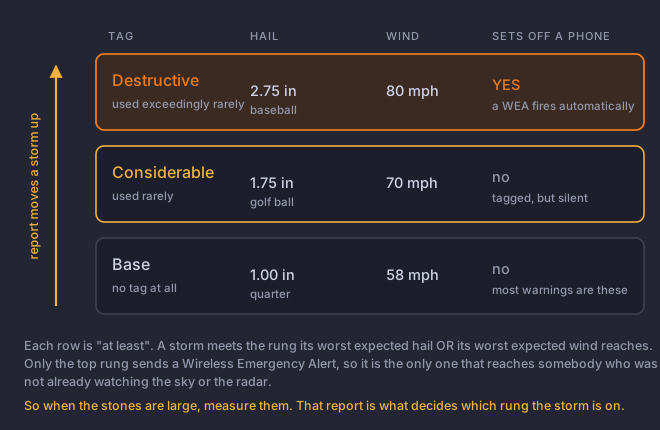
The values are the NWS's own. Base is the unchanged severe criterion, 1.00 inch hail and/or 58 mph, and carries no tag and no wireless alert. Considerable is at least 1.75 inch golf ball hail and/or 70 mph, and also does not fire a Wireless Emergency AlertsThe alerts that interrupt a phone with no app installed and nothing subscribed to. Only some weather products are eligible to send one.. Destructive is at least 2.75 inch baseball hail and/or 80 mph, and a warning carrying it automatically activates a Wireless Emergency Alert on phones inside the warned area.
Late reports
A report made days later cannot help a warning that has already expired. It can still do two things, and they are not small: it feeds verification, and it goes into Storm Data, which is the record that still exists in thirty years and the one every long-term statistic is built from.
This matters most for exactly the events lesson 1 said were missing: the rural ones, the night-time ones, the ones nobody was awake for. If you found damage this morning that happened last night, report it. Say when you found it and when you believe it happened, and say that the second one is an estimate.
Updates, and not repeating yourself
- Send an update when
- Something material changed: the hail got bigger, the tornado formed or lifted, the water is now over the road rather than at the kerb, the damage turned out to be worse in daylight. Say explicitly that it is an update to an earlier report.
- Do not send when
- Nothing has changed and you are anxious, or somebody else on the net has already reported the same event at the same place. Duplicate reports of one event cost the office time during the exact minutes it has least of it, and can inflate the record.
Golf ball hail fell at your house at 21:40. You lost power, and report it at 22:15 when your phone reconnects. What time goes in the report?
The office will check this against a radar scan. Which of these two times has a storm in the right place?The report carries the occurrence time. At 22:15 the storm is thirty miles away, so a report stamped with the call time is checked against the wrong scan and looks implausible. And a 35-minute-old report is entirely useful: golf ball hail is the considerable damage threat tier, and the warning may still be running.