
What the words mean
Flash flood, flood, coastal flood, debris flow. Four separate events with four separate definitions, quoted rather than summarised.
Why this lesson quotes instead of explaining
Every other hazard in this course has one definition. Flooding has four, they overlap at the edges, and each one is a different row in The official national archive of significant weather events and their impacts, published by NOAA and built largely from local storm reports. It is the source almost every long-term severe weather statistic comes from. with a different warning attached to it. A report that says "flooding" makes somebody at the Weather Forecast OfficeA local National Weather Service office. It issues the warnings for its own area, and it is the office your report reaches. decide which of the four you meant, from your location and the time of day. So the wording below is reproduced exactly. A threshold is not a thing to put in your own words.
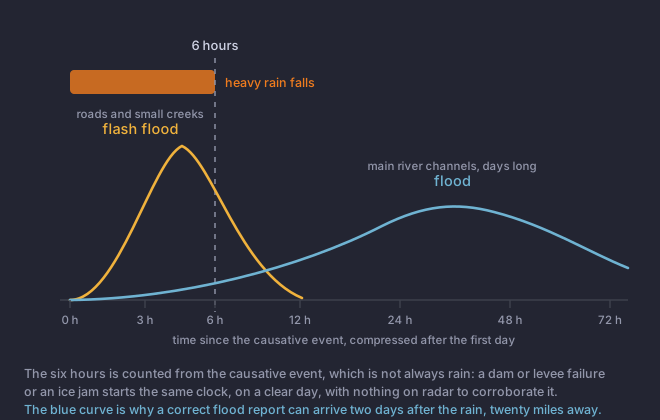
Flooding that begins within about six hours of whatever caused it, counted from the causative event rather than from when anyone noticed the water. The cause is usually intense rainfall, but a dam failure, a levee failure or an ice jam qualifies and can do it on a clear day.
The NWS Glossary, which is the definition the public-facing products are written against:
A rapid and extreme flow of high water into a normally dry area, or a
rapid water level rise in a stream or creek above a predetermined flood
level, beginning within six hours of the causative event (e.g., intense
rainfall, dam failure, ice jam). However, the actual time threshold may
vary in different parts of the country. Ongoing flooding can intensify
to flash flooding in cases where intense rainfall results in a rapid
surge of rising flood waters.
NWS Instruction 10-1605, which is what the event is filed under afterwards, says the same thing with a different emphasis: "A life-threatening, rapid rise of water into a normally dry area beginning within minutes to multiple hours of the causative event (e.g., intense rainfall, dam failure, ice jam)."
Three things are doing work in those sentences. Rapid is the event, not the depth. Normally dry area is why a creek that rises within its banks every spring is not one. And causative event is not always rain: a dam failure, a levee failure or an ice jam produces a flash flood on a clear day, which is the case where radar will corroborate nothing and a human report is the only evidence there is.
Flood, coastal flood, An abnormal rise of water generated by a storm, over and above the predicted astronomical tide. It is the storm-driven part on its own, which is why it can be quoted as a height without saying anything about how deep the water actually got.
- Flood
- Instruction 10-1605: "Any high flow, overflow, or inundation by water which causes damage. In general, this would mean the inundation of a normally dry area caused by an increased water level in an established watercourse, or ponding of water, that poses a threat to life or property." This is the areal event, slower and usually larger. Urban and small-stream flooding are filed here.
- Coastal flood
- Instruction 10-1605: "Flooding of coastal areas due to the vertical rise above normal water level caused by strong, persistent onshore wind, high astronomical tide, and/or low atmospheric pressure, resulting in damage, erosion, flooding, fatalities, or injuries."
- Storm surge
- The NWS definition: an abnormal rise of water generated by a storm, over and above the predicted astronomical tides. Where the coastal flooding is tropical in origin it is filed as storm surge rather than coastal flood, even when the system itself is hundreds of miles away.
- Storm tide
- The water level actually observed: the surge plus the astronomical tide it arrived on top of. The same surge on a high spring tide and on a low neap tide produces two very different storm tides, which is why the timing of a landfall matters as much as its strength.
A slurry of loose soil, rock, organic matter and water, similar in consistency to wet concrete, dense enough to hold particles larger than gravel in suspension. A separate Storm Data event from flooding, and it does not stop where water would., and why it is its own event
A debris flow is not a muddy flood. Instruction 10-1605 as it now stands calls it "a slurry of loose soil, rock, organic matter, and water, similar to wet concrete, which is capable of holding particles larger than gravel in suspension." It is a separate Storm Data event with separate impacts, and it behaves differently: it is denser than water, it carries boulders, and it does not stop where water would.
The products, and which one reaches a phone
- Flash flood watch
- "Issued to indicate current or developing hydrologic conditions that are favorable for flash flooding in and close to the watch area, but the occurrence is neither certain or imminent."
- Flash flood warning
- "Issued to inform the public, emergency management, and other cooperating agencies that flash flooding is in progress, imminent, or highly likely."
- Flash flood emergency
- Exceedingly rare. Reserved for a severe threat to human life and catastrophic damage occurring or imminent. The flood equivalent of a The most severe wording a tornado warning carries, used when a violent tornado is confirmed and heading for a populated area., and used about as often.
Flash flood warnings carry Impact-Based WarningThe system of tags attached to a warning giving where the information came from, how large the hail or wind is expected to be, and the level of damage threatened. Severity becomes a defined field rather than a matter of tone. tags, in place since autumn 2019. They come in three families and the third one is the one that matters to you at two in the morning.
NWS wording for the two that fire. Considerable is "used rarely, when there are indications flash flooding capable of unusual severity or impact is imminent or ongoing and urgent action is needed to protect lives and property". Catastrophic is "used exceedingly rarely, when a flash flood threat to life and catastrophic damage is occurring or is imminent".
One more change is in flight. Under NWS Instruction 10-922 the five flood advisory sub-types were consolidated into a single Flood Advisory, and flash flood watches were folded into flood watches wherever the cause is excessive rainfall, leaving flash flood watches for dam and levee failure, ice jams and burn-scar situations. Beyond that, the NWS is retiring the word "advisory" entirely in favour of plain-language headlines. Its own published flood example reads "Ponding of water in low-lying and poor drainage areas from 3PM to 8PM". As of this writing the agency still describes that transition in the future tense, so expect to see both forms for a while.
A levee gives way on a clear afternoon, four days after the rain that filled the river behind it. Water reaches a subdivision within twenty minutes. What is it?
The six hours is counted from something specific, and the definition names three causative events, only one of which is rain.The clock runs from the causative event, and dam failure, levee failure and ice jams are named in the definition alongside intense rainfall. This is exactly the case where nothing on radar will corroborate the report, which is why a human observation is the only evidence that exists for it.