
When you are caught
A tornado while driving, an overpass, hail, straight-line wind and water over a road. What the NWS actually says, including where it declines to give you one answer.
A tornado, while driving
The NWS guidance, quoted exactly, because this is the one place in the course where paraphrase would be dangerous:
In a vehicle: Being in a vehicle during a tornado is not safe. The
best course of action is to drive to the closest shelter. If you are
unable to make it to a safe shelter, either get down in your car and
cover your head, or abandon your car and seek shelter in a low lying
area such as a ditch or ravine.
- If the tornado is distant and you can tell which way it is going, drive away from it at right angles to its path rather than trying to outrun it along the path.
- The first sentence is the important one: a vehicle is not safe. Everything after it is a choice between worse options, so the whole of this module is about not arriving here.
- A sturdy building beats both options, every time, if you can reach one.
Overpasses
The most dangerous single piece of folklore in spotting, and it has a documented body count.
NWS Norman and National Severe Storms LaboratoryA research laboratory, not an operational office. It develops the techniques forecasters use, but issues no products and takes no reports., on the 3 May 1999 Oklahoma and Kansas outbreak: "highway overpasses offer, at best, questionable shelter not only from tornadoes, but severe storms in general: three people in Oklahoma lost their lives while seeking shelter near or under overpass bridges."
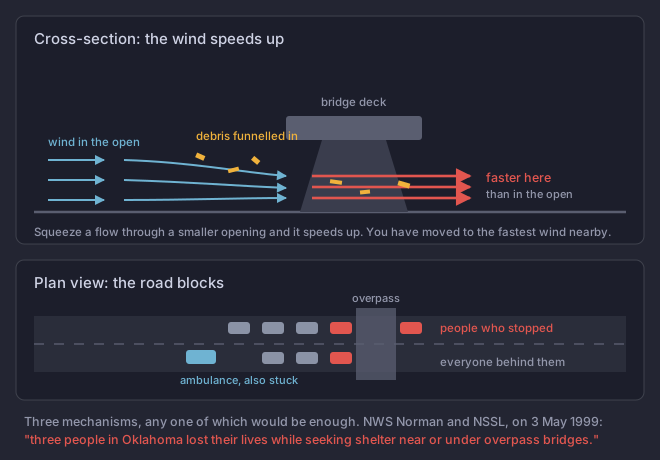
- The wind accelerates. Squeezing a flow through a smaller gap speeds it up. You have gone to the one place nearby where the wind is faster than it is in the open.
- The debris comes with it. Whatever the wind is carrying is funnelled into the same constriction, at the same increased speed, at the height where people climb.
- The road blocks. Vehicles stop on the carriageway and nobody behind them can move, including people who had a plan and including emergency services.
- There is often nothing to hold. Many overpasses have no girder recess at all, just a flat underside and a sloped embankment.
Hail
- Face the vehicle into the hail. The windscreen is the strongest and most shatter-resistant glass on the car; the side and rear glass are not. Pointing into the storm puts the strong glass where the impacts are.
- Get occupants low and covered, away from the side windows, with a blanket or coat over heads if you have one.
- Do not get out. Module 5 covered what large hail does at The speed at which something falling stops accelerating, because drag balances its weight. For hail it sets how strong an updraft has to be to keep a stone aloft while it grows., and none of it is survivable well outside a vehicle.
- Do not shelter under an overpass or a bridge to escape hail either, for every reason in the section above plus the blocked-road one.
Straight-line wind
A segment of a line of storms that has surged forward into a bow shape on radar. The apex of the bow is where the strongest straight-line winds are. and A strong downdraft that hits the surface and blasts outward, producing damaging straight-line winds. It is the general term for what a microburst and a macroburst are size classes of. winds of 70 to 100 mph are a real threat to a stationary vehicle, and much more so to a high-profile one. NWS guidance is to point the vehicle directly toward or directly away from the wind, so that its aerodynamics work with you rather than presenting a broadside.
Then look at what is around you, because in most of the country the wind is not what hits you. Trees and power lines are. A position under mature trees or beside a line of poles is a bad position in a wind event even if the wind itself would not have moved you.
Water over a road
Module 6 is the hazard science and module 6 lesson 4 is why this kills more people than the rest of this module combined. Here it is a driving decision, and it is the simplest one in the course.
These are the NWS figures and they describe moving water. The road surface underneath may also be gone, which no depth rule covers.
A tornado is approaching, you cannot reach a building, and there is an overpass 200 yards ahead. What do you do?
One structure in this question has a documented death toll from exactly this decision.An overpass accelerates the wind, funnels debris into the same gap, and blocks the road for everybody behind you. Three people died doing this on 3 May 1999. The NWS gives two options for a tornado in a vehicle and neither of them is an overpass.